


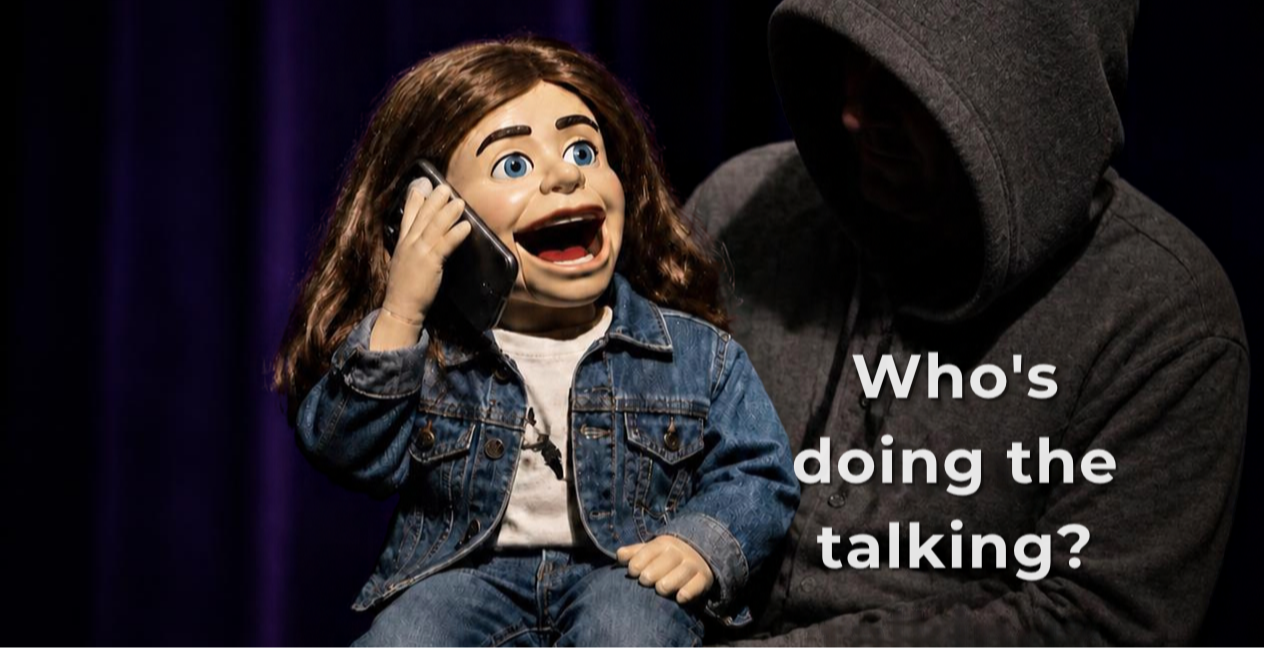
A ventriloquist’s act works for one simple reason. You’re watching the dummy. The mouth moves, the voice sounds right, and your brain fills in the rest.
Scammers are now running the same act over the phone.
A mother in California picked up her phone last spring and heard her daughter’s voice. Panicked. Crying. Saying she’d been kidnapped and needed money sent right away.¹
The pitch was right. The tone was right. Even the little verbal habits her daughter uses when she’s upset were there. She wired $5,400 before learning her daughter had been safe the entire time. What she heard was an AI recreation of her daughter’s voice, built from a few seconds of audio pulled from somewhere online.
This used to sound like science fiction. It doesn’t anymore. Voice cloning has become one of the fastest-growing tools in a scammer’s kit, and it’s built to exploit something every family takes for granted. Recognizing each other by sound alone.
How Fast Is This Growing?
Fast enough that the projections keep getting revised. The Deloitte Center for Financial Services projects that generative AI fraud could cost Americans as much as $40 billion a year by 2027, up from $12.3 billion in 2023.²
And the act keeps evolving. The FBI has warned about what it calls virtual kidnapping. Scammers claim to be holding a loved one and send an altered photo or video as proof, often edited from pictures the family already posted. The latest versions arrive in disappearing messages, so there’s less time to notice a missing tattoo or an odd detail that would give the fake away.³
It isn’t just families, either. A finance employee at a global engineering firm joined what looked like a routine video call with his CFO and several colleagues. Every person on that call was a deepfake. He sent $25 million across 15 transfers before anyone realized none of them were real.²
None of this means every call is fake. It means the old test of “does this sound like someone I know?” may not be enough on its own anymore.

What Does an AI Voice Scam Actually Sound Like?
Exactly like the person it’s imitating. That’s the whole point.
Researchers at McAfee found that just three seconds of audio, about the length of a voicemail greeting, was enough to produce a voice clone with an 85 percent match to the original speaker.⁴ One in four people surveyed said they had experienced an AI voice scam or knew someone who had. Roughly seven in ten weren’t confident they could tell a clone from the real thing.⁴
That three-second threshold is what makes this personal. A birthday toast posted online. A voicemail greeting. A graduation video. Any of it can become the script for someone else’s act.

How Big Has This Problem Become?
Big enough that federal agencies now track it as its own category of fraud. The FBI tied roughly $893 million in 2025 losses to schemes involving artificial intelligence, and about $352 million of that was reported by adults 60 and older.⁵ ⁶
The broader elder fraud picture is even starker. Adults 60 and older filed more than 201,000 fraud complaints with the FBI’s Internet Crime Complaint Center in 2025, a 37 percent jump from the year before. Reported losses reached $7.7 billion, up 59 percent.⁷

More than 12,400 of those victims lost more than $100,000 each, and the average reported loss across elder fraud victims that year was $38,500.⁷
Imposter scams, where someone pretends to be a family member, a bank, or a government agency, are the most reported type of fraud tracked by the Federal Trade Commission, with $3.5 billion in reported losses in 2025.⁸ Among older adults, losses of $100,000 or more to these scams jumped from $55 million in 2020 to $445 million in 2024.⁹

Why Are Families Such Easy Targets?
The whole act runs on urgency. A calm request invites questions. A panicked voice shuts that instinct down before you’ve had a chance to think. Every second spent scared is a second not spent asking who’s really doing the talking.
And the material is usually easy to find. It rarely comes from anywhere sinister. A proud parent’s graduation video. A saved voicemail. A clip for the family group chat.
How Can You Keep Your Family Safe?
The fix is surprisingly low tech. Agree on a private code word or verification question with the people most likely to be impersonated, and use it any time a request for money feels even slightly off.¹⁰ ¹¹
A cloned voice can sound exactly like your child, your spouse, or your parent. It can’t know something the two of you agreed on privately and never posted anywhere. It can be as simple as the family dog’s breed, or where you and your spouse spend the holidays.¹¹
A few rules make it work.
- Choose it together, in person. Not over the phone or by text.
- Don’t save it anywhere digital.
- Change it if you ever suspect it’s been compromised.
- Treat a wrong answer as a hard stop, even if the voice is crying and begging you to hurry.
What Should You Do If You Get One of These Calls?
Hang up. Then call the person back on a number you already have saved, not one the caller gives you.¹⁰ Many of these scams fall apart right there, because the person supposedly in danger answers their own phone.
Can’t reach them? Call another family member who might know where they are before sending a dime. Never wire money or send crypto based on a phone call alone, and treat any request for gift cards as an automatic red flag.
If money has already gone out, report it to the FTC and the FBI’s Internet Crime Complaint Center as quickly as possible. Even after the money is gone, those reports help investigators track new versions of the scam and warn other families faster.
Final Thoughts | Know Who’s Talking
The voice may be familiar. The one doing the talking might not be.
That’s the new reality, and no software update fixes it. What does help is ten minutes at your next family gathering. Pick a code word. Agree that anyone can hang up and call back. Make slowing down the family rule, not the exception.
Scammers count on panic. A question, or even a ten-second pause, is their worst enemy.
If you’d like help thinking through how your family would handle a call like this, or how to better protect the accounts these scams go after, give us a call.
We are proud to be your financial friend. And clarity starts with a simple conversation.
1 Moneywise.com, June 5, 2026.
2 Cybersecurity and Infrastructure Security Agency, 2026.
3 Deloitte Center for Financial Services, 2026.
4 Federal Bureau of Investigation, 2026.
5 McAfee.com, 2026.
6 Federal Bureau of Investigation, April 6, 2026.
7 Fox News, June 11, 2026.
8 Federal Bureau of Investigation, 2026.
9 Federal Trade Commission, June 15, 2026.
10 Federal Trade Commission, Imposter Data Spotlight, August 2025.
11 Federal Bureau of Investigation, May 15, 2026.
12 Federal Trade Commission, 2026.