


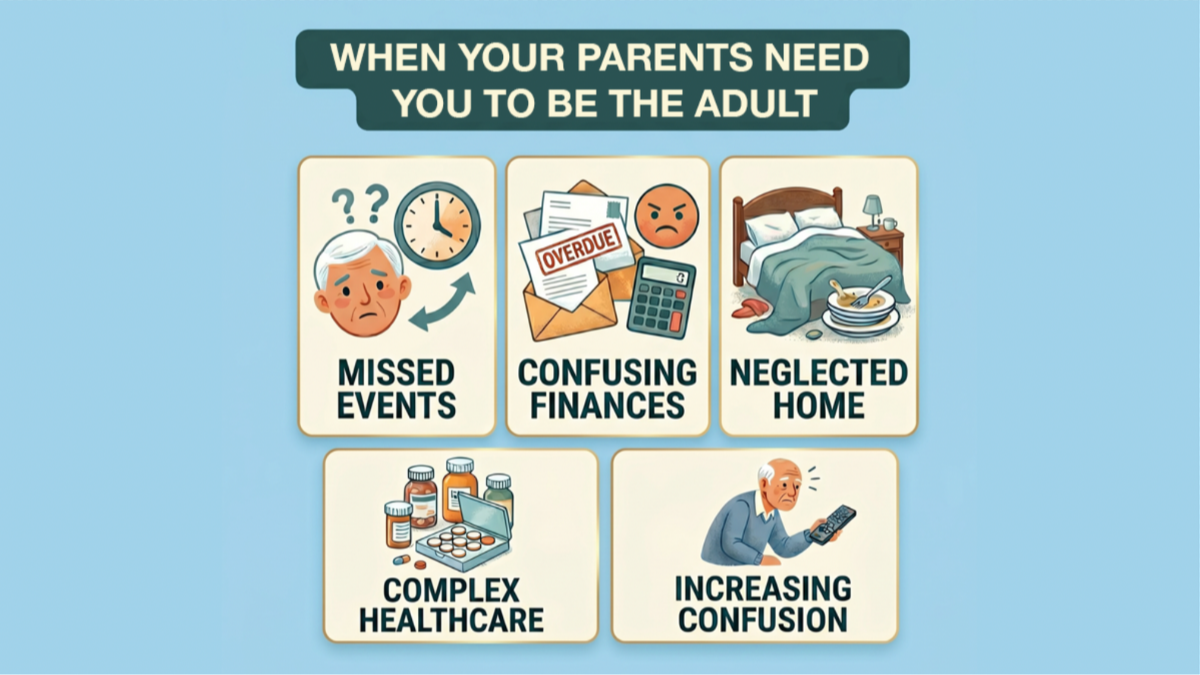
It's hard to spot the exact moment when a role shift is needed. It typically happens slowly, over time, with subtle items stacking up until you notice the trend.
It may be a confusing medical bill. Missed or duplicated payment. A scam text they barely escaped. A repeated question or story.
These small changes add up. And at some point the concerns add up to one conclusion. Action is needed.
The hard reality surfaces and the most difficult question: How do you step in without taking over completely?
It's one of the most complex transitions a family goes through, and most families reach it with no plan at all. A 2026 report found that 27 percent of Americans admit they've never discussed their end-of-life wishes and don't plan to. Forty-two percent say they wouldn't know what to do if a family member passed away today.1
The families who handle this well almost always have one thing in common. They had the conversation before they had to, on their terms.
The Conversation Nobody Starts
Conversations about aging loved ones aren't easy, they can be uncomfortable. And as humans we tend to avoid uncomfortable situations. Behavioral researchers call it the ostrich effect, the tendency to avoid a topic entirely when we suspect it'll be uncomfortable, or when engaging might force us to act on something we'd rather not face.2
And the avoidance isn't one-sided. Most adult children are quietly hoping their parents already have everything handled, so the conversation can keep waiting. But the real value in starting early isn't just practical. It's the quality of the conversation itself. When a family talks through this while everyone's still healthy and in no rush, parents get to say what they actually want, instead of having decisions made for them later..

How Do You Bring Up Your Parents' Finances Without Making It Awkward?
Most families put this conversation off for the same handful of reasons. They assume nothing's really wrong yet, so why force it. They assume there's more time, so why prioritize it. Or they simply don't know where to start, so they quietly avoid it.
Whatever the reason, it rarely holds up once you take a step back. But even that doesn't make the conversation feel any easier.
Framing matters more than most families realize. Raise it as a concern about your parent's ability to manage their own affairs, and even with the best intentions, it can land as criticism. A better entry point starts with you instead. Mention that you've been updating your own estate documents, or that something came up in a conversation with your advisor that got you thinking about the family picture. This small shift, from scrutiny to shared preparation, changes the whole tone.
Keep the first conversation small on purpose. Ask where important documents are kept, or who to call in an emergency. Not "let's talk about your finances." The goal is to open the door, not settle everything in one sitting.
A family meeting can help too, especially with a neutral third party involved. It takes the pressure off feeling like a child is questioning a parent, and keeps the focus on being prepared rather than being capable.
The Legal Document Essentials
A trust is one of the most powerful tools in estate planning, and not just for what happens after death. A properly funded trust can manage assets while you're still alive but unable to do so yourself, avoiding probate entirely and keeping control in the hands of someone you actually chose, not a court.
Fortunately, most trust conversations with a qualified estate planning professional include four additional documents that make a real difference when real problems arise.
Durable Power of Attorney
Designates someone to manage financial and legal affairs if you become unable to do so. The word "durable" is critical. It means the document stays valid even after incapacity. A standard POA becomes void the moment it's needed most. Some POAs are also "springing," meaning they only activate after a formal incapacity declaration, which can create delays at the worst possible time.3
Healthcare Proxy
Designates a specific person with the legal authority to make medical decisions on your behalf when you're unable to make them yourself. Without one named, doctors and hospitals may be left without a clear answer on who's actually authorized to weigh in, right when a decision needs to happen fast.3
Advance Directive
Puts your own treatment preferences in writing ahead of time, covering things like life support, resuscitation, and end-of-life care. It's not about naming a person, it's about making sure decisions reflect what you actually want, rather than a family member's best guess under pressure.
POLST (Physician Orders for Life-Sustaining Treatment)
the one most families have never heard of, a POLST is a physician-signed medical order, not just a stated wish. Medical providers are legally required to follow it immediately in an emergency. For anyone managing a serious health condition or advancing age, it's often the most actionable document of the four.4
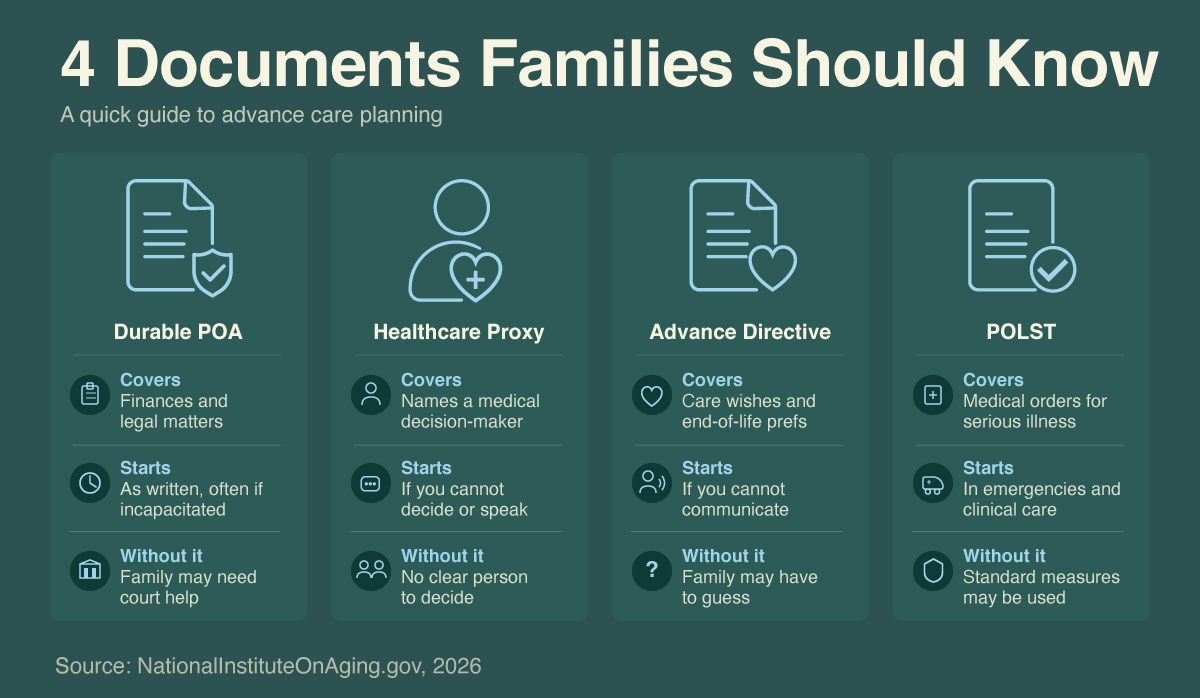
Without these in place, things get complicated. A family that needs to act on a parent's behalf has to petition the court for guardianship or conservatorship. An entirely avoidable step, if the paperwork is in place before it's needed.
Document Your Financial Blueprint
Even families who've had a great conversation and prepared legal documents can hit the same wall. You've got to know where everything is.
Account numbers. Insurance policies. A list of monthly automatic payments quietly running in the background. Where is the will, or better yet the trust, located. Contact details for the estate attorney. Contact information for the financial advisor.
These are exactly the details that matter most in the moment, and exactly the ones that are hardest to reconstruct after the fact.
A family financial blueprint solves this. It's one organized record, built once, and maintained going forward, that gives a trusted person everything they'd need to step in. Bank and investment accounts, insurance policies, pension income, real estate, and key contacts. Don't skip the digital access piece either. Usernames and passwords matter more than people expect, since almost everything is managed online now, and regaining access after a parent loses capacity can turn into a slow, frustrating process if nobody planned for it.
This isn't a someday project. Research suggests cognitive changes that affect financial decision-making can start as early as the 50s, which is exactly why clarity over chaos means starting now, not waiting for a reason to.5
The Uncomfortable Truth About Elder Exploitation
Most people picture a stranger when they think about elder financial exploitation. A scam call. A fake tech support pop-up. Someone who found a vulnerable person and took advantage.
That's not usually who it is.
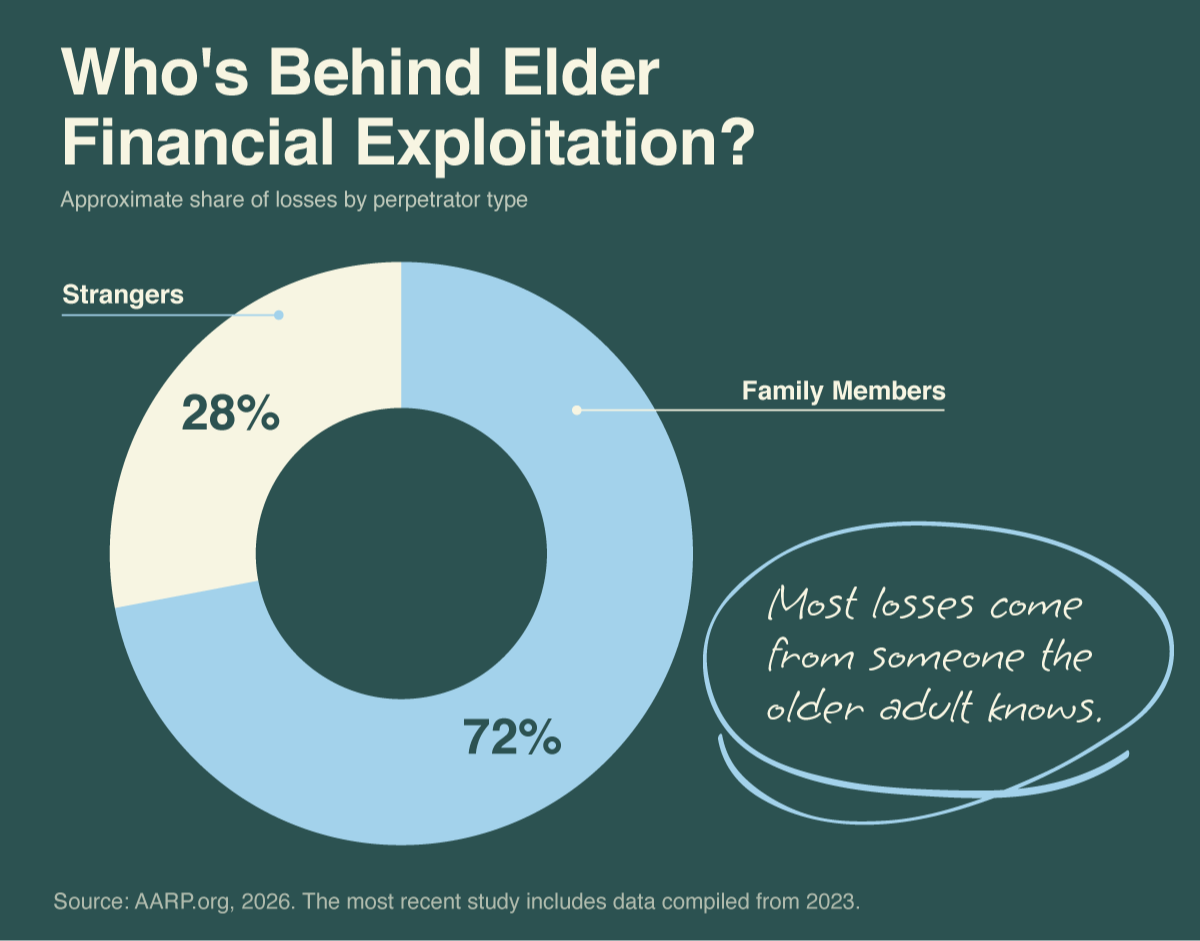
According to AARP research, 72 percent of all elder financial exploitation losses, roughly $20.3 billion out of $28.3 billion total, came from an insider, someone the family actually knew and trusted. Family members. Caregivers. People with legitimate access to their finances. Not strangers.6
And the more a family has, the bigger the target. Higher-asset elders draw more attention precisely because there's more to take.
The warning signs are often hiding in plain sight. Unusual withdrawals. An unfamiliar name added to an account. A beneficiary designation changed without explanation. Unpaid bills despite plenty of resources to cover them.
The fix isn't watching a parent like a hawk. It's structure. It's education. And just a bit of oversight. A parent with a clear estate strategy, paired with adult children who have real financial visibility, closes most of the gap before it ever becomes a problem.
The Truth About Medicare, Medicaid, and Long-Term Care
Healthcare costs rise over time, as we get older, and as our health changes. And there is a common misconception leaving a very large gap in most families' financial blueprint. Medicare does not cover long-term custodial care. It covers short-term skilled nursing care after a qualifying hospital stay, fully for the first 20 days, then a $217 daily copay through day 100, then nothing. It doesn't touch home health care, assisted living, nursing home care, or memory care at all.
An alarming oversight considering 70 percent of Americans over 65 will need some form of extended care, and typically for about three years.7,8
That's a really big gap considering the typical cost of care runs $75,000 to $130,000 a year, depending on the setting.
So what fills the gap? Most people assume Medicaid, but that's a big assumption few understand clearly. Medicaid is means-tested, which means you only qualify once your assets are nearly depleted. So you pay with your hard-earned money, right up until you've spent down close to nothing. There's no version of this where a family skips paying out of pocket. The only real question is how long you're self-funding before Medicaid ever enters the picture, and what condition your assets are in when it does.
And even once someone qualifies, Medicaid isn't the safety net people picture. It's poverty-level care. Fewer choices in facilities, tighter staffing, less say in where a parent actually ends up.
The reality is everyone should self-insure, it's not really optional. But how you self-insure can have a big impact. Paying cash out of pocket is one way to do it, but at what cost. Insurance solutions offer a way to spread the risk and offer protection along the way. Additionally, insurance-based solutions can offer a tax advantage, since qualified long-term care benefits are often considered tax-free.
Final Thoughts
Pull all of this together and it comes down to four simple things that are easily within your control.
Open communication, in advance. Remember, clarity prevents chaos in crisis mode.
A real plan, backed by the right legal and financial guidance working together. Coordinated to meet your needs legally and financially.
Oversight, not surveillance, structure that protects a parent without making them feel watched.
Self-insuring on your own terms, where you are in control, and not by default into whatever Medicaid happens to offer.
None of this has to happen all at once. But it does start with a conversation.
If your family has been putting this off, give us a call. We are proud to be your financial friend. And clarity starts with a simple conversation.
1 TrustandWill.com, 2026
2 TheDecisionLab.com, 2026
3 www.nia.nih.gov, 2026
4 Connellylaw.com, 2026
5 pmc.ncbi.nlm.nih.gov, 2026
6 AARP.org, 2026
7 Medicare.gov, 2026
8 JRCInsuranceGroup.com, 2026